Tips for Using Gas Appliance Safely
Maintaining Natural Gas Appliances
The Natural Gas Appliance Checklist, provided as a public service by Washington Gas and the U.S. Consumer Product Safety Commission, provides guidelines for specific checks recommended by the National Fire Protection Association and the American Gas Association (AGA) for residential natural gas appliances. Have a technician fill out the form while performing your annual inspection. Ask for an explanation of any comments or problems that are discovered during the inspection. Washington Gas and the U.S. Consumer Product Safety Commission recommend annual safety inspections of your natural gas appliances by a qualified technician.
Washington Gas recommends keeping your gas appliance owner’s manuals available and referring to them regularly. These booklets are provided by the manufacturers of the particular models you own and contain the most complete information about your appliances. For more product safety information, visit the U.S. Consumer Product Safety Commission website.
How Washington Gas Can Help in an Emergency
We respond immediately and at no charge to customers for any natural gas emergency, such as escaping gas or a malfunctioning appliance. In the event of an emergency, we may be required to turn off gas service to your home or appliance. If your appliance requires repair or replacement, you will be advised to call a licensed natural gas contractor. As with any major service or repair, you may wish to shop around for services and terms that are best for you.
Tips for Using Gas Appliances Safely
Below are tips on how to safely and efficiently use your gas appliances.
Have a licensed natural gas contractor perform an annual pre-winter check of your natural gas heating equipment — including furnaces, boilers, water heaters, pilot and burner chambers, venting systems, thermostats and/or unvented space heaters. If you see or suspect something is wrong with your heating system, turn it off immediately and call a repair service.
Many gas appliances have open burners. Older models also have pilot lights that burn continuously. It is very important to keep the area around your appliances clear of all flammable objects and substances, particularly gasoline and other fuel containers, paints, adhesives, cleaning solvents and oily rags, which create a fire hazard. Also make sure not use or store flammable products in the same room or area where a water heater or any other gas appliance is installed.
Any natural gas appliance located in a garage or similar location must be installed according to the applicable building code, so that all burners and burner ignition devices are at least 18 inches above the floor.
Broken, rusted, unsealed gaps or rotted-out areas in flue venting pipes release combustion products. Be sure to have the flues and vent pipes replaced and appliances checked by a licensed contractor.
Indoor air quality can be affected when the products of gas combustion are not vented properly. If your appliances require venting through flues (metal pipes), a match test can be used to find out if your venting is effective. Once the burner is lit and operating normally, wait approximately 30 seconds and then hold a lighted match just below the flue-diverter on water heaters, furnaces and boilers. If the flame leans towards you, flutters downward or goes out, the system is not drawing combustion particles outside through the vent or the flue. If you notice these signs, turn off the appliance, air out the building and call a licensed natural gas contractor immediately to inspect the equipment. If the appliance is in an area with an attic fan, kitchen fan or bathroom fan, the fan can set up vent or flue back drafts. Have a licensed contractor check your venting.
Gas appliances and fireplaces use oxygen from the air to operate. When a home is sealed tightly, the oxygen inside can be used up and not replaced fast enough. The lack of air can cause incomplete burning, allowing carbon monoxide to form. Never enclose gas furnaces, water heaters or dryers in a closet or small room without providing openings for air circulation as required by local and state code.
Clean or replace air filters every month during the heating and cooling seasons and every three months during the rest of the year. Clean air filters help your system operate properly and reduce your energy bills.
Bird and animal nests, leaves or loose tiles inside your chimney can block the venting of combustion products produced by gas appliances, posing a CO or fire hazard. Have your chimney checked by a licensed contractor annually during your heating system inspection.
When installing gas logs or inserts in a conventional wood-burning fireplace, pay special attention to the manufacturer’s venting specifications. Many log sets need a fully open chimney damper when burning and some require direct venting to the outside. Please note that gas logs are not designed for cooking.
If you have an automatic dishwasher and the manufacturer recommends a Normal temperature setting for your hot water heater, ask your plumber about anti-scald devices for your shower and sink taps.
Natural gas water heaters are highly efficient and provide a generous amount of hot water whenever needed. For maximum efficiency and to prevent scalding accidents, lower the temperature of your water heater. Do not turn your water heater above 120 degrees Fahrenheit. Warm or Low should be the appropriate setting on most water heater dials that do not have numbers.
Range-top burners or ovens should never be used for home-heating purposes, even during a winter emergency. Leaving burner flames on and unattended is a fire hazard and oven burners operating continuously can use up indoor oxygen and lead to the production of deadly carbon monoxide.
Range-top burners may not light when turned on, or may go out when a pot boils over. In both cases, gas is still being released. Turn the burner off and wait about five minutes to let gas concentrations drop before attempting to relight the burner.
Sometimes, part of a burner does not light at all or the flames look ragged and yellow. This usually means that the burner ports are clogged. Turn off the gas and clean out the tiny holes of the burner with an open paper clip or metal wire. Do not use a toothpick, which may break off in the burner.
Ovens must be able to circulate air inside when they are operating. Do not cover the holes in the bottom of the oven with foil. Always leave an inch of space between pans and oven walls.
Do not cover broiler pan holes with foil; fats can collect and may ignite.
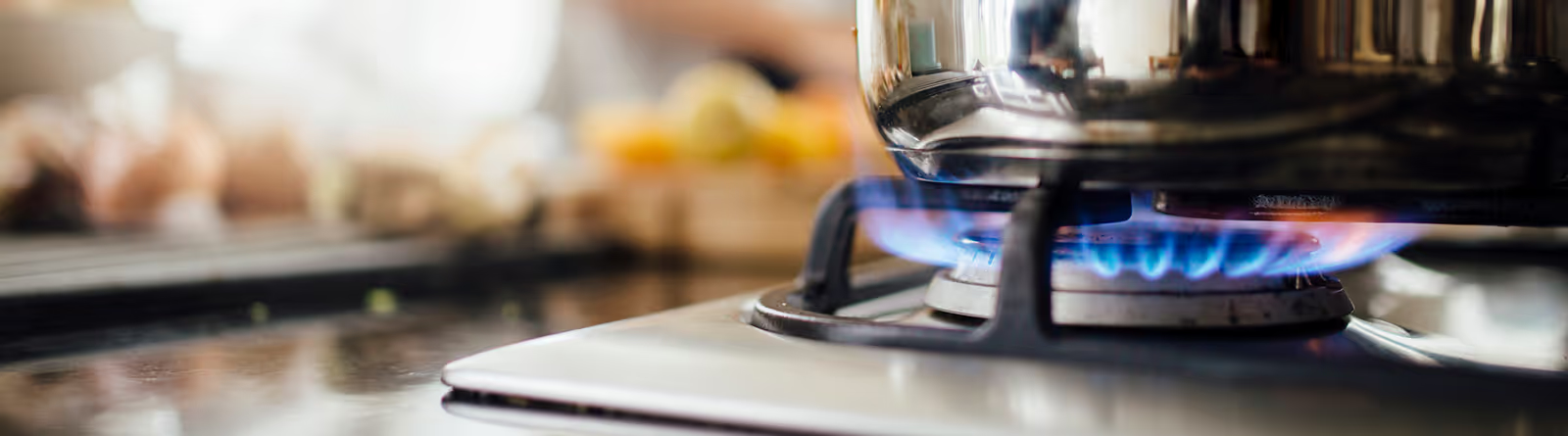
When cooking, burner flames should not be allowed to rise up around the outside of a pan. Adjust the flame to match the size of the pan.
Gas grills must be lit with the top open. A natural gas grill intended for outdoor use should never be used indoors. All outdoor grills can produce deadly carbon monoxide and are designed to vent in the open air.
Keep the range clean and wipe up spills promptly. Do not store fats and oils on or over the range.
Remember to check cooking progress often to avoid pots bubbling over and potentially putting out the burner flame. With the burner on, natural gas will escape even if the burner is not lit.
Dryer exhaust goes through a flexible metallic vent pipe or rigid vent pipe to the outdoors. Manufacturers do not recommend flexible vinyl hoses. If there are cracks or holes in the vent pipe, it needs to be replaced. Make sure the outside exhaust hood is in place and the flapper inside of it moves freely.
Check venting periodically to remove lint and dust. Lint in the vent pipe can cause a fire.
Items cleaned with a spot remover or similar product give off flammable vapors. These items should never be dried in a gas dryer; air-dry them instead.